
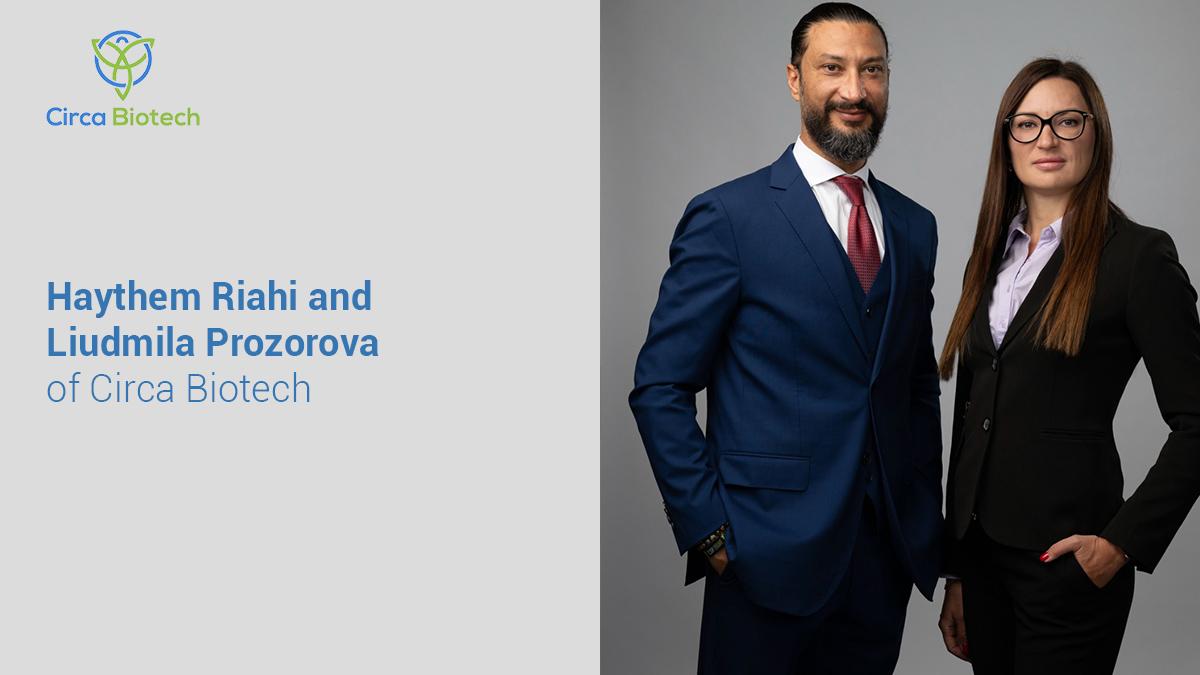
Founded in 2020, Circa Biotech is a UAE-based climate-tech startup that farms insects to recycle food waste into useful products such as animal feed, fertiliser, and materials that can be used to make sustainable aviation fuel.
We spoke to founder and CEO of Circa Biotech Haythem Riahi and co-founder and COO Liudmila Prozorova about how their business started and where it’s heading in the future.
Gulf Economist: Let’s start by talking about what inspired you to start this business.
Circa Biotech: The UAE is one of the world’s top food wasters per capita. We saw an opportunity to turn this challenge into something positive.
GE: What specific problem were you trying to solve?
CB: We wanted to solve the urgent environmental and economic problem of food waste in the UAE and globally. Every year, the UAE generates approximately 3.5 million tons of food waste. More than 90% of this waste ends up in landfills, releasing methane (a greenhouse gas 28 times more potent than CO₂). This is a big problem and contributes to climate change, but importantly also represents a lost opportunity to reclaim valuable nutrients and resources. At the same time, industries like agriculture and aquaculture are facing growing pressure to find sustainable alternatives to imported animal feed, while aviation is trying to move away from fossil-derived fuels. Circa Biotech tackles these issues simultaneously through an innovative waste-to-value approach.
GE: That’s such an innovative approach. How did you fund your startup in those early days?
CB: Through personal savings, early accelerator funding, and angel investments.
GE: Did you make any mistakes in that formative period? What did you learn from them?
CB: We underestimated the time required for technical validation at scale. It taught us to embed risk buffers and deepen early-stage industry partnerships.
GE: I imagine your vision has evolved somewhat over time?
CB: Yes, we started with insect protein. Now, we’re pioneering sustainable aviation fuel (SAF) feedstock, aligning with global decarbonisation goals and closing the circular economy loop.
GE: Has your funding changed alongside this evolution?
CB: Yes, we’ve secured over $800,000 in equity, grants, and SAFE notes and are now closing a $3m round with strategic energy and aviation partners.
GE: If you were to pick out some of the pivotal moments in your growth journey, what would they be?
CB: Partnering with ADNOC for SAF pilot testing, receiving the Majra Sustainability Stamp, and signing an MoU with the Ministry of Climate Change and Environment.
GE: Were there tough times during that journey? How did you cope with them?
CB: There were times, especially during regulatory delays, when our resolve was tested. But every setback reinforced the importance of our mission.
GE: So when you were initially setting up your business, what kind of culture were you hoping to create?
CB: Mission-driven, science-first, and resilient. We encourage intellectual curiosity and long-term thinking.
GE: Did that impact how you approached hiring? What were you looking for in terms of talent?
CB: Integrity, adaptability, and ability to act decisively. Plus, a genuine passion for solving environmental challenges.
GE: Were you conscious of bad past experiences and how you wanted to avoid them?
CB: Yes, we wanted to avoid bureaucracy and embrace agile, interdisciplinary teamwork.
GE: Let’s talk about the future now. What’s next for your company in the short term?
CB: Launch our second full-scale facility in the UAE, close the SAF certification process (CORSIA RSB), and establish a US commercial presence.
GE: And what would success look like to you in, say, five years?
CB: Operating multiple plants globally, supplying SAF feedstock to leading refiners, and contributing significantly to methane reduction and energy transition goals.
GE: Let’s take a step back and talk about the wider business environment where you operate. What’s good and what needs improvement in the UAE startup ecosystem?
CB: The ecosystem is ambitious and well-funded. However, deeper sector-specific accelerators and clearer access to pilot opportunities would boost scalability.
GE: How easy or hard was it to navigate the business setup process here?
CB: Free zones such as Masdar made it relatively smooth, though food waste regulation still lacks centralised oversight, which slows implementation.
GE: How has SANDBOX enabled your business to get to the next level?
CB: SANDBOX offered access to capital, visibility, and mentorship, connecting us with institutional investors and validating our business model in the UAE ecosystem.
GE: What advice would you give to someone looking to start a business in the UAE?
CB: Find mission-aligned government partners early and validate your solution’s relevance to national priorities, especially sustainability and food security.
GE: How would you describe the UAE investment landscape more broadly?
CB: It’s changing rapidly. There’s a growing appetite for climate tech, but startups must show commercial viability early to attract institutional backing.
GE: Let’s finish by discussing inspiration. What’s a book or podcast that has helped you in your thinking?
CB: The Lean Startup by Eric Ries. It reinforced the importance of iteration, validation, and mission alignment in scaling an impact-driven company.
GE: And how about an actual founder or business leader – anyone who you found inspiring?
CB: Yvon Chouinard (Founder of Patagonia) was an inspiration. His business model as a force for environmental good profoundly shaped our ethos.
GE: Thanks so much for your time, Haythem and Liudmila.
*A call-out to early-stage tech founders – are you setting yourself up for success?*
SANDBOX is a highly competitive investment programme which offers $150,000 in funding, mentorship from seasoned experts, and direct exposure to a network of regional and international VCs. Held twice a year in February and September, SANDBOX draws over 1,000 applications per cohort, with only 2% coming through the selection process, making it one of the region’s most sought-after programmes for early-stage tech founders.
SANDBOX is run by Oraseya Capital – a $136m venture capital fund backed by Dubai Integrated Economic Zones (DIEZ). As the UAE’s most active investor, Oraseya Capital backs startups from pre-Seed to Series B from $150,000 to $3m.
For more information, go to www.sandboxaccelerator.com.