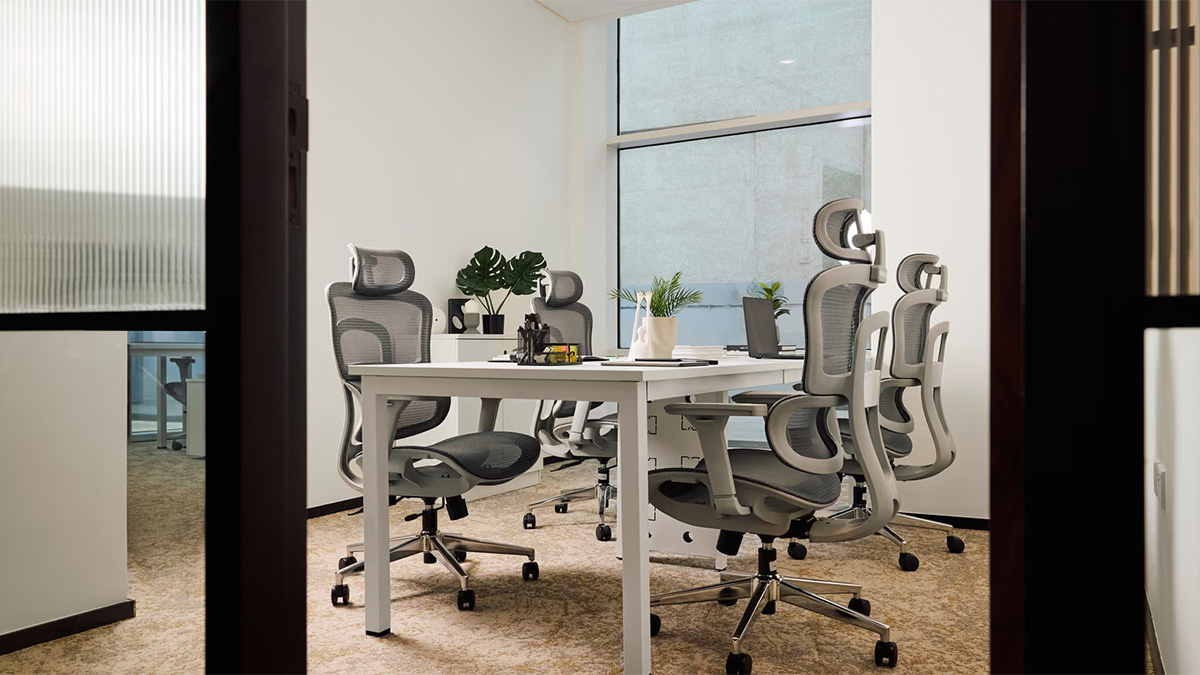
After operating flowork in Dubai, the relationship between a city and its flexible workspaces becomes hard to ignore. The success of the model is far more dependent on the conditions around it than most operators care to admit.
What makes a flexible workspace genuinely valuable tends to be everything surrounding the desk rather than the desk itself, whether that's the ease of operating, the quality of service, the people you're surrounded by, or the ability to access infrastructure without building it yourself. A beautiful office alone doesn't deliver all of that. Dubai creates particularly strong conditions for a model that does.
What coworking actually needs to work
Coworking, as it was originally conceived, centred on shared desks and spontaneous interaction, but the market has evolved considerably since then. Think of the founder who needs a desk today and a private office in six months, or the international business that wants a professional base in Dubai without committing to a long-term lease, or the growing company that needs meeting rooms and additional desks without expanding its permanent footprint. The common denominator, in each case, is flexibility.
Useful as flexibility is on its own, a successful workspace has to go further and actively remove friction from the working day. That means creating an environment where businesses can arrive and operate immediately, where meeting rooms, technology, reception, hospitality and support are already in place, and where the experience feels considered from the moment someone walks through the door.
Worth noting, too, is that community cannot simply mean putting people in the same room and hoping something happens. What makes the difference is an environment where different businesses, industries and people naturally cross paths while still being able to focus on their own work. That might produce a client relationship or a partnership; it might be nothing more than a useful introduction. Either way, the workspace starts to offer considerably more than the square footage a business occupies.
Why Dubai is particularly suited to it
Few cities have been as deliberately shaped around movement as Dubai. People move here to start businesses, expand companies, access new markets and build regional headquarters. Teams are increasingly distributed across cities and countries, while founders and executives often operate across several markets at once, creating a natural demand for workspaces that can move at the same speed.
Rather than spending months fitting out an office and negotiating with multiple suppliers, a business entering Dubai typically wants to arrive, operate professionally and scale when the time comes, which is precisely where the serviced and flexible office model becomes relevant.
Beyond the practical setup, Dubai attracts people who are genuinely comfortable with change. Careers here tend to be less linear, businesses evolve quickly and opportunities frequently sit across industries and geographies, which means the workspace needs to accommodate that same fluidity. At flowork, the office functions as business infrastructure rather than a fixed asset. A company might begin with a smaller office, use meeting rooms for client conversations, host an event when it launches something new, and draw on a podcast or content studio when it needs to tell its story. Managing all of that separately was the traditional approach; bringing it into one environment makes operating considerably easier.
Running alongside all of this is the hospitality dimension. Dubai has set a high bar for service across hotels, restaurants, retail and travel, and people naturally start to expect the same quality from the environments where they spend their working day. The implication is that workspace cannot simply be functional; it has to feel genuinely good to use.
The role of the operator
This is where I'd push back on the idea that a successful operator simply provides a well-designed space and lets the city do the rest. Dubai creates the right conditions, but it's the operator who ultimately determines the experience.
Manufacturing community through a calendar full of events doesn't work, but neither does leaving it entirely to chance. It comes from understanding who is in the building, creating relevant opportunities for people to connect and providing enough touchpoints for relationships to develop naturally.
The same logic applies to hospitality, which is really the accumulation of small decisions: how someone is welcomed, how quickly a problem is resolved, whether a meeting room works when it needs to, whether the environment feels professional enough to bring an important client in, and whether a business feels genuinely supported rather than simply accommodated. Cumulatively, those details determine whether a workspace becomes somewhere people rent or somewhere they genuinely want to operate from.
What unsuccessful spaces get wrong
Among the most persistent misconceptions in the industry is the belief that design alone creates demand. Beautiful interiors help, but they're increasingly a baseline rather than a differentiator, and the same is true of community. Adding networking events to a calendar doesn't automatically produce meaningful relationships, just as adding desks doesn't create a stronger business environment.
What the strongest flexible workspaces tend to have in common is a clear-eyed understanding that they are, ultimately, service businesses. They combine real estate with hospitality, operational support and community while giving companies the flexibility to use only what they need. Given the speed at which businesses and people move through Dubai, the city provides an unusually strong foundation for that model. The opportunity for operators, though, extends beyond simply providing somewhere for that movement to happen; it's to make doing business within that environment actively easier.