Headline figures from Dubai’s construction pipeline risk giving a false sense of comfort. By 2030, according to recent market research, total office stock in the emirate is forecast to rise from around 110 million square feet to 119 million. That increase represents nearly nine million square feet of additional supply, roughly 55% more than was delivered over the previous five years. On the face of it, that looks like a market responding rationally to demand.The problem is that a significant portion of the incoming supply is already committed before it is finished. Occupancy across Dubai’s office market stood at approximately 94% in Q2 2026, according to CBRE, one of the world’s largest commercial real estate services and investment firms. JLL’s Q2 2026 market analysis showed Dubai’s citywide office vacancy had fallen to 6.1%, down from 7.7% a year earlier, with prime inventory so constrained that occupiers were actively moving to Grade A and Grade B alternatives, pushing Grade B vacancy down to 8% from 10.9%. The supply-demand imbalance, JLL noted, reflects genuine market fundamentals rather than speculation.
What the vacancy data actually tells you
Average office rents in Dubai increased 13% year-on-year in Q2 2026, with prime rents growing 16%. JLL has noted that the supply-demand imbalance reflects “genuine market fundamentals rather than speculation”, with prime vacancy at 0.3% and citywide vacancy at 7.7%. The citywide figure, taken alone, is not alarming by global standards. The difficulty sits almost entirely at the Grade A end, and specifically within the most sought-after commercial districts.DIFC office rents have reached AED 537 per square foot, with Business Bay at AED 151 per square foot. For an international firm planning a regional headquarters, or a financial institution expanding its Dubai operations, the practical reality is that choice has become one of the scarcest things in the market. The gap between what leading occupiers require and what the market can supply is not a pricing problem that can be resolved by paying more. At its core, the shortage has been deepening for several years.
A pipeline that is already spoken for
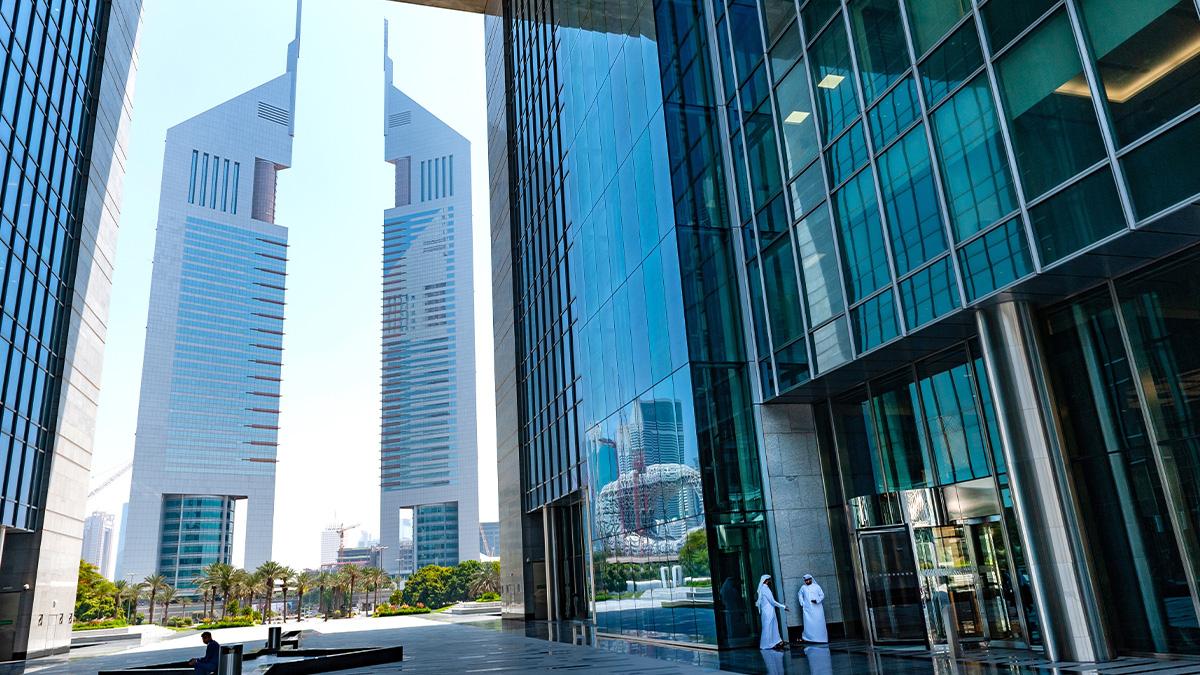
DIFC Square, one of the year’s most significant Grade A completions, delivered approximately 600,000 square feet of office space and achieved 100% pre-leasing before handover. Tenants that secured space within the development include Bank of Singapore, Deutsche Bank, Gallagher Insurance, Herbert Smith Freehills Kramer, Moody’s, and TP ICAP. A building that size, occupied entirely before a single employee moved in, illustrates the supply dynamic more clearly than any vacancy statistic.Immersive Tower, the next major Grade A delivery in the DIFC corridor, is scheduled for completion in July 2027 and already has a significant volume of space under offer. Approximately 1.9 million square feet of new office supply is scheduled for delivery across Dubai during 2026, with the pipeline expected to increase to more than 4.2 million square feet by 2030. Much of the forthcoming Grade A supply is anticipated to be pre-leased or absorbed by existing occupier demand before completion. That pattern, repeating across successive developments, is the structural issue the headline figures tend to obscure.
The companies driving absorption
The number of companies registered with DIFC exceeded 10,000 by the end of the first half of 2026, with active registered companies rising 30% year-on-year. Wealth and asset management increased 35% while banking and capital markets rose 13%. AI, FinTech and innovation companies reached 1,933, a 39% increase year-on-year.These numbers represent occupiers making real decisions about physical space. DIFC registered 775 new companies in Q1 2026, a 62% annual rise, with March alone up 59% year-on-year to 258 firms, even during the period of regional conflict. Companies with long-horizon mandates were making long-horizon decisions about where they needed to be, regardless of short-term disruption. The pressure on available Grade A stock is a direct consequence of that pattern, and the pace of formation has not slowed.
The flight to certainty and what it reveals
Renewals rose 6.1% in 2025 while new leases fell 21.1%, a clear “flight to certainty” with limited relocation options driving occupiers to lock in existing space before competing landlords can bid rents higher. That behaviour is rational given the conditions, but it also compounds the shortage. Each tenant who renews to avoid the risk of losing their space reduces the turnover that would otherwise create options for incoming firms.Dubai’s rental contract registrations jumped 24.6% year-on-year in Q2 2026, driven primarily by new contracts reflecting sustained business confidence. Average market rents held at AED 238 per square foot in Q2 2026, the first quarter without rental growth since the first half of 2021. Savills reads that as a period of stabilisation rather than a correction, and the underlying vacancy conditions support that interpretation. Rents are not retreating – they have paused after a sustained rise, in a market that remains structurally undersupplied.
The smaller occupier that the headline data underweights
Transactions below 500 square feet rose 17% quarter-on-quarter in Q2 2026, accounting for 66% of all office leasing activity, reflecting sustained demand from SMEs, start-ups and new market entrants. The volume of smaller-scale occupiers active in this market is an independent demand dynamic that operates alongside the institutional absorption at the larger end.
D33 is explicitly designed to accelerate exactly this kind of activity: more businesses, more sectors, more international operators establishing a Dubai presence. The agenda targets a doubling of Dubai’s economy by 2033, raising annual foreign direct investment from AED 32 billion to AED 60 billion. If those targets are even partially realised, the demand pipeline for commercial space has structural momentum well beyond the current cycle.
Why the Grade A shortage is a category problem
Demand remains particularly strong within key commercial districts and free zones including DIFC, TECOM and DMCC, where pre-leasing activity continues to absorb a significant portion of future supply before completion. The overall vacancy rate, running at approximately 7.7% citywide, gives the impression of a market with room. The reality within the districts where corporate and financial sector tenants concentrate is considerably tighter.Banking and finance accounted for 32.5% of office demand in H2 2025, while technology contributed 23.1%, both sectors concentrated in Grade A space in core districts. When two of the most active demand segments are specifically drawn to the category in shortest supply, the citywide vacancy figures become a somewhat misleading guide to whether the market is meeting the needs of its most significant occupiers.
What the 2030 arithmetic actually suggests
Vacancy rates across Dubai’s office market are projected to fall from approximately 4% in 2025 to just 0.7% by 2030, even as the emirate records one of its largest office construction cycles in more than a decade. That projection deserves attention. The most significant construction cycle the city has seen in a decade has been fully factored in, and the forecasted outcome at the end of it is still a market running at effective capacity.DIFC alone has a long-term pipeline of 7.7 million square feet planned through to 2040, a commitment that signals the supply side has understood the scale of what it is facing. The more uncomfortable observation is that the demand driving that commitment arrived well ahead of the planning cycles now responding to it. Buildings not scheduled to open until 2028 are already drawing pre-lease enquiries. The companies that shaped the current shortage are in the process of shaping the next one.
The question worth asking is not whether Dubai is building enough office space, because on the current projections it is not, but whether the city’s capacity to attract and absorb institutional demand has structurally outpaced any reasonable supply response. That distinction matters more than individual vacancy and delivery numbers, and the data available today makes it impossible to ignore.