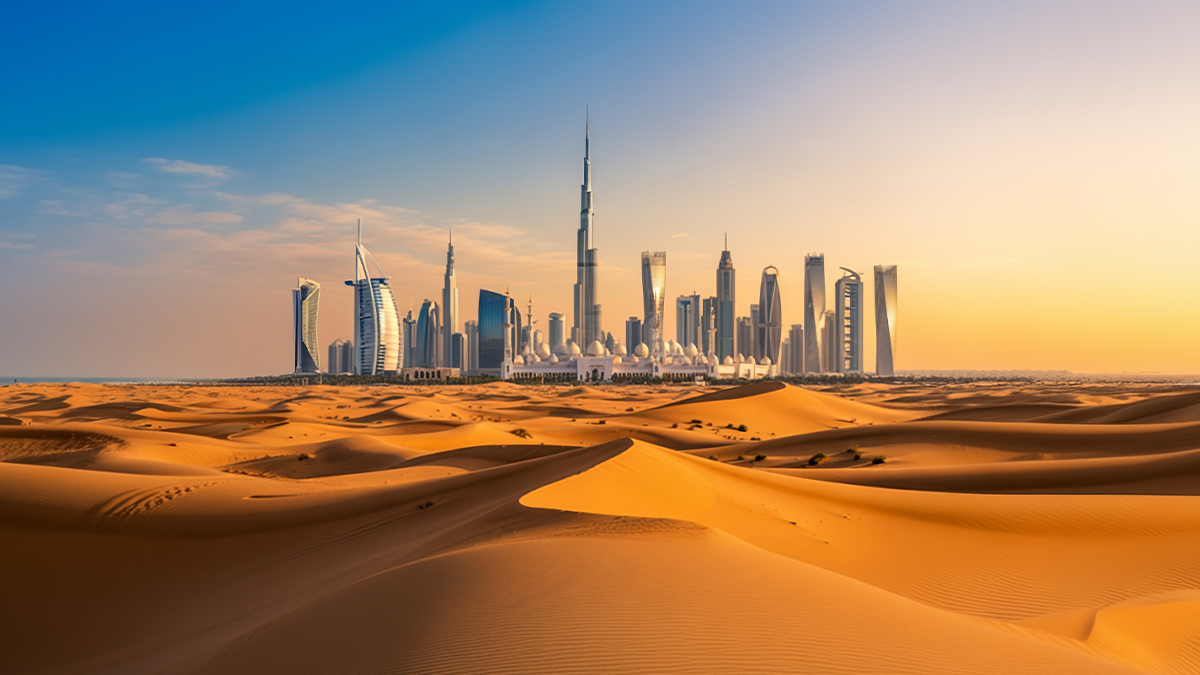
In the last decade alone, the UAE has transitioned from being a fast-growing regional hub to a global economic powerhouse. While the sheer pace of change has set the country in a league of its own, the UAE's success lies in its ability to turn its long-term national ambitions and initiatives into reality.
Each year, the UAE sets new targets, and it often exceeds them – 2025 being a case in point. Initial forecasts projected the country’s economy to expand by 4.4%, before being revised to 4.9%. Predictions for 2026 look even more promising, with the Central Bank forecasting a 5.3% expansion for the year ahead.
This article explores the UAE’s prospects for 2026 and why the upcoming year could be its best one yet. It also looks at why the country is seen as a viable headquarters for businesses, how the government’s policies are accelerating the UAE’s development, and how an entrepreneurship-first business environment is reaping rich dividends.
The shift from regional base to global HQ
An international outlook has always been a major factor in the UAE’s success, but as we move into 2026, there’s a marked difference in how foreign companies view the country. In the past, the UAE was a place to set up a regional branch. Today, it is an automatic choice to set up a global HQ.
There are several interesting reasons why this has come to pass. The UAE’s political and economic stability in 2025 stands in stark contrast to the rest of the world, offering a sense of predictability. In addition, the UAE’s well-regulated business environment and its central location make it a hub for businesses at the crossroads of Europe, Asia, and Africa.
There’s also an interesting shift in the types of international businesses that set up in the UAE. While global giants continue to establish a presence here, there’s also a notable uptick in solopreneurs, startups, scale-ups, and other SMEs. For the latter, established ecosystems, industry-focused free zones, and vibrant networking communities further accelerate integration into the business community.
It’s also never been easier to get a business up and running. The UAE’s world-famous free zones continue to attract businesses of all sizes from around the world, thanks to 100% foreign ownership rules in most sectors, favourable tax laws, fast-tracked licensing processes, a wide range of visa options (golden visa, green visa, remote work visa, investor/partner visa, etc.), and the ability to sponsor dependents easily, among others.
The role of National Visions in growing the economy
The UAE’s policy is multi-layered, with several intersecting initiatives aimed at boosting long-term growth. One such initiative is the Digital Government Strategy, which has streamlined licensing, compliance, and regulatory processes. This digital-led transformation has cut costs and reduced the time businesses spend on administrative work, enabling new companies to focus on revenue rather than red tape.
Running parallel to the Digital Government Strategy, the National AI Strategy 2031 and Fourth Industrial Revolution Strategy aim to place advanced technologies at the heart of the economy. By prioritising AI, automation, robotics, and advanced manufacturing across a wide range of core sectors (including healthcare, finance, and logistics), the UAE government’s long-term vision promises to set an example for the rest of the world to follow.
Zooming in, there are additional initiatives, such as NextGen FDI, that aim to actively attract high-growth international companies by reducing entry barriers through faster licensing, banking access, and residency support.
Each of these initiatives sits within the broader strategic arc defined by UAE Vision 2031 (also known as We the UAE 2031) and UAE Centennial 2071. Together, these two programmes offer a level of long-term certainty and stability that businesses crave, aligning investment, talent, and regulation around clearly defined economic objectives – the primary goal being non-oil growth.
Entrepreneurship in the UAE: lower barriers, higher ceilings
The UAE has entrepreneurship and ambition encoded into its business environment. The country continues to outpace the competition across several indices, including ranking first globally in the Global Entrepreneurship Monitor 2024–2025 Report for the fourth consecutive year.
This confidence and belief are mirrored among the country’s citizens – 70% of Emiratis see ample opportunities to launch a business locally. The importance of aligning entrepreneurship with national priorities is also clear – as many as 80% of new entrepreneurs are willing to prioritise socio-environmental impact over profitability.
This new generation of entrepreneurs looks different from the stereotypical lone founder. Many of them are experienced professionals running a consultancy or selling digital products, all based on years of specialised industry knowledge. Others are building scalable businesses alongside a full-time job, gradually making the switch once steady revenue and scalability are possible.
Additionally, the popularity of remote work and flexible employment models in the UAE has made it easier for professionals to reassess their career goals. The rising confidence in the UAE’s regulatory environment has further reduced the perceived risk of starting a business, making the barrier to entry lower than ever.
As more individuals start businesses, the economy benefits from greater diversity and innovation. SMEs are the backbone of the UAE economy, making outsized contributions to the national GDP. Because entrepreneurship is seen as something ‘normal’ and accessible, the current business environment in the UAE is reminiscent of the early days of Silicon Valley, where failure is reframed as learning and success stories inspire budding founders to believe that anything is possible.
Economy 2026: the year ahead in the UAE
Each of the trends discussed so far points to an economy on the ascendant. International investment brings capital and global connections, while business-friendly government policy provides stability and direction. Today, entrepreneurship feels possible for anyone.
This accessibility has a highly positive effect on economic resilience, as a more diverse local business base is better able to weather global shocks and black swan events. However, this does not mean there are no headwinds. Increased competition will put pressure on pricing, talent retention and resources. Housing availability and public infrastructure will also need to keep pace with population growth.
For businesses that can outrun the competition and differentiate themselves in meaningful ways, the possibilities are endless. 2026 promises to be an exciting year for entrepreneurs, and it is safe to predict that the UAE’s economy will continue to grow from strength to strength.